- Home
- About Us
- Our Products
- Investors
- News
- New Product Pipeline
- Contact Us
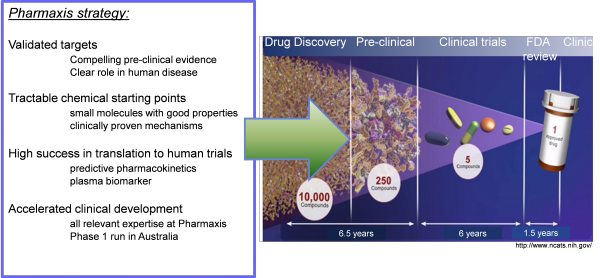
Pharmaxis' research efforts are focused on discovering new therapies for respiratory diseases. Our strategy requires the recruitment of high quality dedicated scientists and building a centre of excellence capable of delivering clinical candidates for development. In addition, we forge alliances with academic and institutional laboratories throughout the world to assist in our endeavours. The products of our research are wholly owned by the company.

Pharmaxis' first commercial product, Aridol is approved for sale in Australia, major European countries, Korea and has been approved for marketing by the United States Food and Drug Administration. Please visit the Aridol product page for further information.
Pharmaxis' key product in development, Bronchitol, is a drug designed to reduce the amount of mucus build-up in the lungs of patients suffering from chronic respiratory conditions.
Pharmaxis is developing Bronchitol for diseases including cystic fibrosis, bronchiectasis, chronic bronchitis, and patients on ventilators in critical care hospital wards. Please visit the Bronchitol product page for further information.
PXS25 — targeting lung fibrosis
The Phase 1A trial of our new drug candidate, PXS25 completed in February 2010.
The trial was designed to determine the tolerance and pharmacokinetic profile of PXS25 following intravenous administration. The trial investigated five ascending doses of PXS25 in 40 subjects. At all doses, PXS25 was found to be safe and well tolerated with a pharmacokinetic profile consistent with a drug that could be delivered once per day.
Pulmonary fibrosis is a degenerative disease of the lungs affecting more than 500,000 people in the major pharmaceutical markets. The average life expectancy on diagnosis is four years, with no approved therapies available outside Japan.
A patent for PXS25 has been granted in Europe and in the USA.
More information on our patents can be found at Patents.
PXS4159 Family — promising new candidates for asthma
In another research project, our drug discovery team has now designed a large library of small molecules that inhibit a critical protein that is implicated in the inflammatory response and organ damage associated with chronic immune mediated diseases such as asthma.
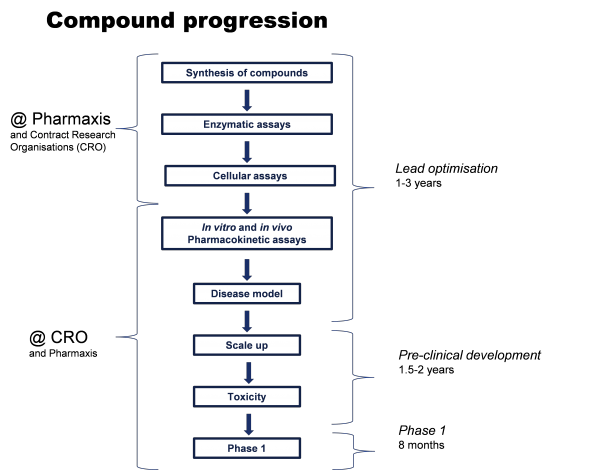
We are in the process of selecting a development candidate to begin scale up manufacture and pre-clinical safety studies prior to evaluating the compound in human trials. In parallel, we continue basic research to explore its other potential clinical uses for this series.
ASM8 - targeting severe asthma
ASM8 is an inhaled, innovative drug candidate in development for the treatment of severe asthma. ASM8 has a novel mechanism of action and is based on a multi-target approach to the management of inflammation. ASM8 uses proprietary RNA-silencing technology acquired with Topigen in February 2010 and consists of two modified oligonucleotides designed specifically to inhibit the synthesis of key receptors for pro-inflammatory mediators.
ASM8 has been shown to be effective at very low doses in a first Phase II, placebo-controlled study that evaluated the effects of a once-daily inhaled dose of ASM8 over four days in patients with mild to moderate asthma. ASM8 was safe and well tolerated and systemic exposure to the drug was minimal following inhalation.
A Phase 2A dose profiling study met its pre-defined primary efficacy and safety endpoints and ASM8 was found to be safe at all doses tested and particularly effective at an inhaled dose of 8mg once per day. Compared to saline control, at this dose, bronchoconstriction following allergen challenge (as assessed by change in FEV1) was reduced by 32% (p=0.03) during the early phase of this response and by 49% (p=0.002) during the late phase of this response. In addition, inflammation as measured by sputum eosinophil count, 7 hours and 24 hours following allergen challenge was reduced by 49% (p=0.02) and by 57% (p=0.007) respectively.

PXS TPI1100 - treatment candidate for COPD
PXS TPI1100 is a unique, inhaled, multi-targeted phosphodiesterase (PDE) inhibitor that targets PDE isoforms 4B, 4D and 7A and is in development for COPD. Inhibition of PDE 7 is synergistic with inhibition of PDE 4 in reducing inflammatory cell activation and chemokine and cytokine release in the lung.
PXS TPI1100 is administered by inhalation and systemic exposure to the PDE inhibitor is minimal. It is expected that this very limited systemic exposure, coupled with very low dosing, will result in a product that is largely devoid of the systemic side effects that are problematic with small molecule PDE 4 inhibitors.
PXS TPI1100 has been evaluated in preclinical models of COPD. The key findings were that PXS TPI1100 is very effective in reducing neutrophils influx and key cytokines in an established smoking mouse model of COPD.